

Scanning the Horizon
In which we get the last PET scan, in the last year of my mother’s life, and I don't turn to stone.

I. Hospital
“Did you look at the scan results yet?” The resident asked, assessing how down the shitter we already knew we were.
No, because we have OODLES OF SELF CONTROL. We must have been her practice round for breaking awful news, a learned skill. She nodded slowly and her eyes went from my dad to my sister to my mom to me, and then flickered to nowhereland.
“The cancer is everywhere,” she said. “We’re concerned.”
Concerned. Oh, OK, thanks guys!
We held hands and didn’t move, and if you don’t move the idea is that you can make time not move too. Have you tried? It’s like a kid thinking if they cover their eyes, you cannot see them.
In that moment, you could say all four of us had cancer, and cancer most especially had us. There was not one terminal person, but four people bound together in a terminal.
My shrunken mom sat up on the table, on the kind of crinkly paper my kids aggressively shredded at the pediatrician’s office, staring at the wall over her feet, which were swollen with edema. There are famous paintings of Jesus’s feet from this same perspective.
The possibility of needing hospice so soon, only three months after the pancreatic adenocarcinoma diagnosis, was now a rabid bat trapped in the space with us, swooping and zooming and rushing past our ears.
I wanted to wash mine out with listerine.
The resident offered us a box of kleenex, a wild insufficiency, when tears were possibly the only thing that felt good: “Take your time. Take as long as you want,” she said.
OK, I WANT IT ALL. (Although a poet, I enjoy being literal).
YOU HAVE NO IDEA HOW LONG I WANT.
She left the room. I imagined her exhale as the door closed. Her sweaty armpits. Her rich black hair in a ponytail, held together, like so much of life, by a cheap rubberband. I imagined the subsequent debrief.
That’s why MSK cancer hospital owns the entirety of the Upper East Side of Manhattan, real estate overlords. So that they can leave people stranded with their anticipatory grief in each of the many rooms, and there is still another room, like an Escher painting collapsing on itself under close inspection, in which to see the next patient.
I wanted the oncologist to take it back when it was his turn to talk to us. To look at the results, apologize for the resident’s novice misread, and say, “Your mom is doing marvelously. The chemo was a perfect solution. The cancer has backed the fuck off. See you in a year!”
Not: “It is no longer safe to give you chemo.” All dry, despite the doctor’s notorious empathetic warmth on ratemydoctor.com. Not: “I told you I would tell you when it was time, and it is time.”
OH IS IT THOUGH. ANALOG OR DIGITAL OR COSMIC.
Not: “Choose which hospice provider you want,” FROM A LIST OF IDENTICAL SOUNDING ONES, LIKE LIBERAL ARTS COLLEGES– “and be in touch Monday.”
I did not want to be in touch Monday, because I was hoping it would just never be Monday. I can be very practical.
The way we stood in that room after they left us was pure reverence, the quiet like a fifth person. The way we couldn’t think of any jokes to crack was reverence, standing at the gate of a wildness we didn’t have nouns for. The way we eventually cracked a joke was reverence, and the way it fell to the ground, like a bit of meaningless ash after an important paper is burned, was also, you guessed it, reverence.
I felt my esophagus go insane with spasms of desire, trying to force my whole life back up through my throat.
TAKE IT BACK! I wanted to yell at the resident, at cancer, and at the pitiless universe. And how I wished I had something to turn to, besides myself, the beige walls, the thick door, who would say, there there, my darling, dying not only taketh away, but also giveth.
But all I heard was the sound of the psuedo-protection of paper over an exam table as my mom shifted her weight, permanently uncomfortable.
My paternal grandparents had faith as Christians; my maternal grandparents too, as Jews. In their deaths, the lord was a shepherd, not a side character, a gatherer of the weary, not a literary device.
Even my 7 year-old admitted from the bath, about her thorny feelings, “I talked to God about it.” And I, who talks to trees about my issues, asked, “About what?” Cloaking my nosiness in journalistic objectivity.
And she shrugged. “Things.” God, not me. God, not me.
On the cross, Jesus bows his head before our collective situation, but that’s because– you know what he is doing there? Dying. He doesn’t have the neck strength to maintain eye contact. He doesn’t have the lymph movement to summon tears. It’s not just reverence. It’s atrophy.
What if we believed dying was a valuable stage of life, not just the unfortunate capstone of disease process?
Could reverence disrupt the second arrow of suffering before it flies from the bow?
Does being alive, like birth itself, just have to hurt and so, like birth, open us completely?
There was no option B. In this unremarkable room, I could feel my strengths of character squeezed into being. I just couldn’t say what they were yet, except my marrow bellowing here we go, the way one shouts voicelessly in a dream to no audience.
And if the thing you fear isn’t what comes to be at these appointments, just wait your turn. Perhaps even Jesus, who I project onto as a coping mechanism, would have wanted to read his medical results, trying to get ahead of dire news and potential unwanted future.
Scan’s clear, buddy, the physician would declare. But you might have some other shit coming down the pipe that evades detection by our current technology. So the best advice I can give you is keep your Heart Open, and let yourself feel Reverence at least once per week.
OK then! Preventative care plan received.
Reverence is the way my mother’s hand felt in mine, when there was no other language left. A magnificent attention, keeping company and connection in ineffable sorrow.
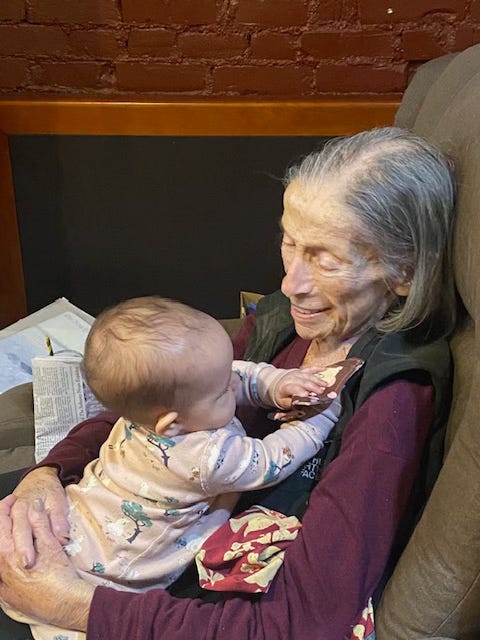
Reverence was the baby, stacking plastic blocks underneath the home hospital bed where my mother lay in her sleep coma, delighting when they fell, as if gravity were just a personal charm.
Reverence is the way my child’s hand feels in my hand, now, after the fact, asking me, but how can you live without your mother? Like, how?
Reverence is deciding never to look at any of her imaging, the yellow brick road of tumors leading from the pancreas to the kidney to the adrenals to the lungs to the abdominal cavity, where the nodules bathed like nymphs in the Adriatic. The resident’s synopsis was enough.
And because all medical images are now digital, I was denied the pleasure of tearing the PET results into pieces and throwing them out the hospital’s gigantic window— which wouldn’t open anyway, with its reinforced glass, built only to be shut.
It was just a pretend portal. Don’t be silly! Otherwise, someone might be tempted to jump, opting out of the punishing cancer altogether, passing up one final complimentary Lipton Tea from the lobby kiosk. In a scan of the sky, the patient would appear as a soaring, transitory blur.
“OK, “ my mother might have said, another wild insufficiency.
What was she supposed to do, just let go? We hoped dumbly that maybe we’d be the lucky-ish ones, her prognosis closer to 9 months, or even the province of the luckiest, a year. Albeit those extra months would have had her chemo-ravaged by vomit, diarrhea, nausea, and exhaustion.
And now? It could be mere weeks.
What is a week in a death crawl? How many minutes, or seconds does it include? Can you subtract that from your piddling portion of infinity? This is the kind of math problem my 10 year-old gets his jollies from, quizzes me on, unsatisfied with my “I don’t know,” while I make him a bowl of oatmeal. “Here’s your breakfast,” I say.
“Can you even try to answer it,” he asks, exasperated. “You’re not even trying.”
“That was me trying,” I assure him. “I tried to listen to you all the way to the end of the question.”
It’s hard to suck your teeth and eat oatmeal at the same time but he pulls it off.
All I knew, standing there with my family, was that this world is amazing and terrible, and not at all like a math problem. Things don’t add up. There are inexplicable factors.
Some angels must have shaken us from our time paralysis in that bland exam room, with nothing at all on the walls, not even a pastel watercolor painting of a wind-tugged sailboat or prairie in its delirium of browns and low-lying clouds, more at sea and depressed than you were.
These angels eventually pushed us out of our chairs, into our coats, and into the maze of the hospital, then spat us into the maze of the street, and the maze of the valley of death, which looked a lot like Manhattan.
When the veil lifted, how would my mother pass through? Would the paper crinkle? Would she claw at it, crazed, unwilling to not be?
II. Home
Outside the sprawling hospital, the sun was held like an offering in the late winter tree branches, as if they were chopsticks clinging to a blazing egg yoke. A bright specimen in god’s tweezers. I would have to present it this way to the children: a slicing, inarguable fact.
I rarely went anywhere without the baby, and now I could not blame the weight in my chest on her. When I got home, my small mob of children greeted me at the door: “Is she better?”
We had explained metastasized cancer. We had explained “not getting better.” But children are always willing to let reality wrinkle, to lean into the wishful part of thinking. I shook my head.
“Ema doesn’t deserve this,” said my 10 year-old. “She’s such a good person.” Implying there are people who do deserve it, who are not good people, and for once I didn’t argue with him.
I just sat on the couch with my husband, holding a smooth stone from our shelf in one hand, the other supporting the baby to nurse.
I thought of the magic pebble that hapless Sylvester had stumbled upon in the wish-granting William Steig book. To protect himself from a lion, he misused his magic and turned himself to bolder in a panic. What is true protection when you face the inevitable? Not becoming rock, but its opposite. To be totally Tenderized, not to wish things to be different than they are– even the wishing to be different.
The baby picked at my mole, which stung, and my husband, seeing me wince, wordlessly clipped her nails, a parenting task that has always made me cringe with inadequacy. This is how it works: some of us are losing our parts, while others are growing new ones.
As my mother’s daughter, how could I accept that her body, which had made me, was entering its final inflammatory stage? Could she teach me what to do when it was my turn?
I could do Reverence, at least once a week, towards whatever. We die alone, but we hold this pain together.
My 7 year-old broke my reverie, shouting, “Mom, can you go buy some more pea crisps!” which is just a chip pretending to be a vegetable, and hers just one of the million tiny satisfiable wants that propel us through our allotted days. The mundane always intervenes in anguish. I can count on that. She skidded into the room, stopping short at the couch. “Are you crying because of the chips?”
I shook my head, and handed her my rock, “Let’s see if the wishing stone will do your shopping.”
Instinctively, she petted it. I could almost feel her wishes– or was it mine?-- crystallizing in her still small hand, the same one that had punched my uterine lining for months.
I wonder: Is reverence the way Mary, perplexed and agitated with sorrow, looked at Jesus’s sagging body and thought, that very chest was once inside of me?
And could not fathom otherwise.
Or his last glimpse of her before he lost consciousness, as he thought but couldn’t say, in this endless night that love made for us, will you know where to find me?
If the resident asked again, in a generous re-do, “Did you look at the scan?” I’d confess, “You know, I did! I’m going for Health Proxy of the Year! Forgive me for assuming I could understand without a medical degree. But her scan showed a radiant body riddled with stars, warm metabolic yellows and reds against the pitch black sky, the Perseids fizzing all over the place.”
And when the resident wrinkled her brow, unsure how to interrupt me skillfully enough to inform me, with no hopeful adjectives, that the cancer was spreading rapidly, I would interrupt her first, because she hadn’t yet understood.
“Listen,” I’d say, handing her tissues, turning off her iPad, muting her blood test results forever. “Somewhere in the lower quadrant of her scan, closest to the margins, a small child has wandered off from the blanket on the beach where her parents lie on their backs looking up at the night splendor. Their rose wine is uncorked, a loaf of sourdough and a jar of butter has tumbled into the sand. These are the lumps, you see, nothing more.
And the child calls out nervously for her mother, who laughs and calls in response, ‘We’re still here, my darling, watching the pattern unfold. Just keep walking towards my voice, sugar. Don’t step on the bread. I’ll keep talking til you find me.’”
For You
My mom’s oncologist, Dr. Andrew Epstein at MSK, really was wonderful– among the most skillful a person could ask for. Here is his 1 hour video on person-centered care, which everyone deserves to receive and at which he was a master:
My mom would 100000% want you (Yes, you) to vote in November in the midterms. That would be her act of reverence and resistance. Here are the obstacles to doing so, and what you can do about it, and must do about it — NOW: https://campaignlegal.org/update/what-you-need-know-about-save-act (spoiler alert, get all your documents in order, which may take T I M E and E F F O R T).
I just learned the poet Lucille Clifton died in 2010 on my mother’s birthday– Feb 13. I consider Clifton a mentor, although she is an ancestor now and I never worked with her directly– I did hear her read and speak and laugh at Dodge Poetry Festival. So embodied, so clear.
Try this poem, on the death of Fred Clifton.
so hard so long such a marathon to grieve the good mother.
no-essay assay! reverence, reverie— your writing just now is in such a liminal space: such a thicket
of feeling & thinking you’re moving through here, dear SNO. Thank you with a bow.
o, “boulder” but I love thinking of it as bolder