

Last Supper
In which my children teach me to optimize the now, from dust unto dust-busting

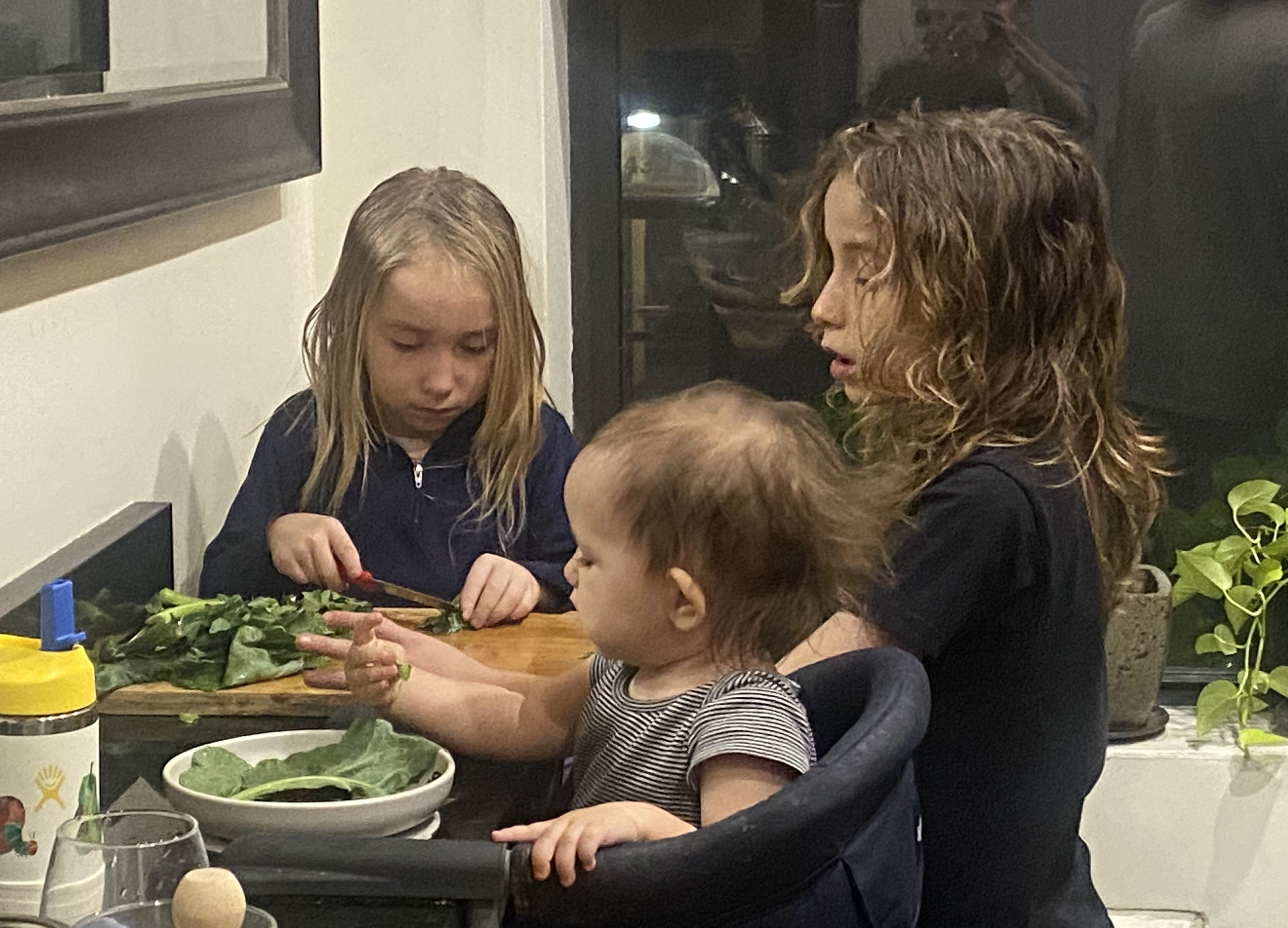
At dinner on a regular Tuesday, Aria, 7 years-old, starts bawling over her purple cabbage: “I just really want to have a great day and a great life, because when I am dead, I won’t get to!”
OK, girl, me too.
This lamentation is about so much more than the affront of me putting a quarter teaspoon of red lentils on her plate. No– She is Verdi’s Tosca, who has just discovered the state firing squad has used real bullets on her boyfriend, instead of the mock execution they had promised.
I’ve been reading, and the problem with reading is the haunting. At the very beginning of EB White’s essay “The Death of the Pig,”-- sorry– the author’s pig perishes. There is no dramatic wondering: will the animal live (to become ham)?
What we don’t know is how the narrator will bear it. The pig’s death defies the natural order in the writer’s schema. Thinking himself the appointed gentleman-farmer executioner, he’s upstaged by an unidentifiable porcine illness.
It turns out that death of other –any other– is also a death of self, a drama in which the self is exchangeable. In the middle of it, White eats dinner at a neighbor’s house, while the pig, bucking its pig nature, refuses even milk.
And here, in the farm stall of my kitchen, the children three abreast, I haven’t even plated the leftover Tandor chicken–normally acceptable in the trough– and Aria is treating it like the Last Supper.
Except at the Last Supper, no one sat at a marble, yogurt-splotched counter for dinner, looking at their loose teeth in the bar mirror. I know this because it’s appeared throughout millenia in paintings as an incredibly long banquet table made of thick wood, ringed with a lot of plaintive, robed and frankly bored-looking dudes.
Parenting is a sport in which you must be ready for any move at any time. I steel myself for my children to file their usual food complaints (“this chicken is too…chickeny?” or just “Really?”), but instead, Aria rails against the utter disappointment of the completely ordinary.
Maybe she needs a little more gristle or friction in her days. To kill the chicken herself. To harvest the lentils– a bushy, annual legume.
The baby– anarchist, javelinist, town crier– sees an opportunity for insubordination: she flings her cabbage, rice, and chicken bits.
“Eat your dinner,” Ro reminds Aria, the 11th commandment, allo-parenting. “With your mouth closed,” he adds, commandment 11.5, unnecessarily invoking manners.
“But I’m crying!” Aria explains, crying.
“Mo, mo, MO!” yells the baby. Master of object permanence, she points at the fridge, currently the cilantro morgue. She’s holding out for those steroid-addled blueberries I bought in a moment of situational weakness at the grocery store.
Death, we’ve learned, removes all of your decorum. My mom drooled when she was too weak to swallow, and too weak to close her lips around a straw. Her mouth was constantly parched, like a person being punished in a fable. The things they tell you about the stages of the body shutting down are largely true.
It all goes downhill eventually, so why tie yourself in knots of propriety? Put your elbows on the table, bawl your longings out into the soggy entree, extract the nectar of your Tuesday eve! If everything is an option, why do we live so narrowly?
“And today was just a medium day! What if I never have a great day?” Aria carries on, turning to see her aggrieved face in the bar mirror. By this point Tosca had jumped off a parapet, landing on a trampoline out of sightline.
Ro, the 10 year-old leveler, rolls his eyes, as per his station in life. “You’re being dramatic,” he says, and squirts hot sauce like a bloody show over his scoop of rice. To each his own tongue blisters.
These days, he keeps his existential struggles in his emotional fanny pack. It’s been a long time since he called me to come to his bed at night, to cuddle while he dissolved into sobs, acutely aware that one day I would die. That day could be tomorrow. But he’s got a whole minecraft bunker to build, first.
I miss, with an ache, the unbridled version of him who wept over the fact that his loved ones were not permanent fixtures in a benevolent universe. That love was not enough of a force to keep anyone here, in the familiar sense. That he was so small, and the diameter of the universe so bloody infinite. We clung to each other as he processed this.
But we don’t get to seal our children at a given stage. Being means constant revision. We watch them barrel past our concept of them into their next iteration, faster than a baby can throw a pea (and she is fast). Even the planets, which we memorized in kindergarten, aren’t static. Pluto has been altogether disqualified from our solar system.
2
His plate reminds me of the photos my friend sent recently of her brain tumor operation, which I can’t stop looking at: the creases of the white matter and its traffic jam of blood vessels. The cancer tricked her body into vascularizing a tumor, siphoning nourishment for its own largess. A surprise seizure, evaluation and surgery revealed the enormity of the growth.
I cannot imagine how she holds this new reality, and maybe she can’t either. After all, Tosca’s boyfriend was supposed to rise from his crumpled obeisance. White’s pig was supposed to frolic ignorantly, and succumb to the butcher’s practiced stroke. I saw with my mom how a chute opened from the land of the healthy to the land of the ill, and there was no rope to climb back out. Great days were now out of stock.
My mom never really accepted the abrupt shift in status to terminal pancreatic cancer patient. She was not able to make peace with being in late-stage illness. To be urged to enjoy the time she had was merely more pressure on her organs. Enjoy what, this nausea? This embarrassing weakness?
How to make contact with whatever is within us that symptoms cannot touch? It was too much work. She accepted getting her feet massaged and watched today’s news loudly. Same old shit would come on tomorrow, and eventually she wouldn’t be around to hear it.
There were moments: my sister washed my mom’s chemo-thinned hair awkwardly in the kitchen sink, and she sighed with pleasure. My dad so tenderly held her hand, repeating how happy he was with their life together, and her eyes softened as her calves bulged with fluid with nowhere to go. She felt the sun on her face for the last time in the garden, too emaciated to sit for very long, “Oh, Darling!” playing on the portable speakers. But a great day? Not sure.
Do all 24 hours have to be awesome to count? How about 6 hours? Or 2?
In the pictures, I see my friend’s skull sawed open, the brain exposed, the tumor excised. This was not a chance my mother got. No one dared float the possibility of removing anything, not an organ nor its beneficiaries. The oncologist proposed so long as her health allowed we would hose the adenocarcinoma with chemo to slow the growth down. The growth would not be slowed. It was unstoppable, a narcissistic imperialist, everything for it and it alone. Ultimately, the treatment did nothing.
Aria looks at herself in the bar mirror, and seeing her tears falling only intensifies the tears.
“Abra!” the baby announces, throwing her water cup at Aria’s plate; the chicken ricochets onto the floor. She throws her spoon next, and the Basmati rice scatters as if behind the departing car of newlyweds. Then her napkin.
“YOU mess EVERYTHING up,” Aria says. I think– and hope– she means the baby, who is meant to challenge order– and not me.
But, don’t we all? Does greatness rely on a wrinkle-free day? Or on the ease and acceptance with which we rebound from our messes, back into a state of connection? Into the resonance of seeing and being seen, even, or especially, at our most vulnerable?
I believe death is the ultimate fucker-upper, and frees us from our delusions of stasis. Our best laid plans, scattered like paper when a fan is turned on. And the fan cares not, following the mechanics of its programming.
“No throwing!” Aria says, as the baby throws a stray pea straight into her eye.
The baby’s aim, if I may say, is truly excellent. A++++ on the ages and stages questionnaire– all but the finale which asks, “If given a cheerio and a bottle, does your baby put the cheerio IN the bottle?” Nah, zero, but in the other nearby hole?
“No!” the baby says, her linguistic power tool. But to whom, to what? The baby doesn’t deign to specify. If she were in a movie, she’d extend her plump wrist and hold back a tsunami while Islanders fled.
So too: “NO!” I said to death, suggesting we could cut a back room deal, when my mother was in her last stiffening stages. I thought I’d try it, at least, as if we were two toddlers fighting over a beloved toy, our bodies hunched with agonistic ownership. And you know what death replied?
Nothing. All things already rest in its handsy hands. He simply dust-busted my mother right up.
There are parables about this, of course. Where the very thing you seek to avoid is attracted to you like fruit flies to an overripe nectarine.
I can’t stop thinking about White’s pig. It’s just a pig, but in its demise, and the gutting arc of empathy the narrator follows, we see how, once again, all of life is connected to all of life. We are all going to wind up at the last supper table asynchronously, so pass the fucking soy sauce, please.
Is a great life one composed of the maximal number of great days? If so, how many to qualify? Or could your life be composed of serially shitty days— those of plague, ostracization, violence— but still there is something regal within?
Later, reaching for her hand, I think to ask Aria what she means (you can send my MacArthur genius award to our package room): “What would make your day great, pumpkin?”
“I don’t know,” she wails, “Dunkin Donuts?”
Oh? Not a positive mindset? Not service to others? Not gratitude practice? A glazed chocolate with sprinkles? I can do that, sure.
How many of us bemoan the exact life we have, with all its weird particulars? And then, when death shows up at the rag tag potluck, we gasp, “Oh Fuck! I didn’t even crack my embossed gratitude journal, let me at least fill out one page!” And death is like, “Finish your chicken. Go to bed. I need to clean the kitchen. You had your chance and you donated it.” (I’m not sure death talks like that, but maybe on a day when he hasn’t had enough protein).
3
Aria watches her tears dry, and shifts the conversation, as often happens, from feeling to thinking, personal tragedy to ontology. “Mom, where did the first word come from?”
Girl, I wonder the same!
She becomes a rubix cube of wondering. “How does a voice get made? I mean, who made the first word?” She’s eating the rice she’s picked up from the floor, grain by grain, out of her hand and you know what I do? I say nothing. God, my self-control is legendary.
In some versions, this is where you bring God into the picture.
I wait. That’s one thing I’ve learned to do.
“Vocal cords,” says Ronen. “They vibrate.”
Aria’s not happy with the physiologic answer. “How did someone even say the first word, how did they know it was a word if they didn’t have words? I just can’t figure it out!” She’s pacing now, chicken in hand, and this dinner will never, ever end. We’re in socratic territory.
“VOCAL CORDS,” my son repeats, because louder is clearer. “VOCAL CORDS.”
“That’s not what I mean,” she says.
“I know,” he says, “but it’s what I mean.”
Later, he looks over my shoulder at my writing: “That’s not what I said,” he corrects me. His form of intimacy is the closeness required to set the record straight.
“Writers don’t have to be strictly factual,” I say, shutting the laptop. Teachable moment, or maybe I’m just feeling caught putting polish and coherence on our incoherent, unpolished lives.
“Well, you definitely weren’t,” Ro concurs.
“What did you say then?” I ask. He stays close to me, despite his antipathy, curled against my back. He’s not choosing his words carefully; he’s playing to win.
“Not what you wrote.” He scoffs.
“OK, well, do you want to be right, or helpful?”
“Right.” He says, and breaks the reverie, prancing off with his kindle to evade bedtime.
And I think, is that the kind of person you are? Is that who I gave birth to?
Outside my bedroom door, he whispers to Aria, while tooth-brushing, something about how science is more powerful than emotion. But what about the science of emotion? What about Electrons bonding despite all efforts?
When the baby exhales into deeper sleep, the kind that merges her briefly with the multiverse, with all creatures that have ever been, I manage to free myself, and yes, go dust-bust stray food bits.
Wow, I’m really living. Down on my knees, restoring order. Finishing what I started. What beauty will I later extract from this mess? Probably nothing. And if there is nothing beautiful, what was there?
I talk to my mom, since dust-busting was her love language, and the kitchen one of her zones of genius.
Mom, side with me here, weigh in, at least: at the last supper, did Jesus say, “Green beans? Really? Again?” No he fucking didn’t. In fact, Jesus supposedly identified his betrayer during the meal, which would make anyone lose their appetite and reach for a Tums.
Is my job to make my children’s life great? Because that’s a lot of work. And anyway, am I not my children’s original betrayer, since the only guarantee that comes with birthing them is the inevitability of death? What a ruse.
Sounds pretty bad when you stack it that way. And here Aria is just wanting a goddamn granola bar for dinner. Is that really too much to ask?
Of course, there is nothing special about the present. But it’s the teaspoonful of time scooped for us from the infinite. In America, it’s our only universal healthcare.
Keep your eye on me, mom, on us. Come huddle with me here, under the kitchen counter, vacuuming shredded chicken and stampeded cruciferous.
We’re in the time of declarative Greatness, which anyone with eyes can see is deeply degraded. And me? I’m really going places, as per my destiny. Anywhere a mouse or basmati grain can, anywhere a chicken femur or rambling vein can, anywhere a question can.
I’m chasing Pluto as it falls off the memorization list of kindergarteners. I’m coming to find you among the constellations, making last wishes in the face of a firing squad. Even though you fed us carob covered rice cakes, I know you’d give my children whatever sweets would light up their very souls.
I admire, briefly, how (my) cleaning scratches the past missteps from the record. I wonder if the trees on our street, visible through the half-lowered kitchen blinds and appearing fatigued, complain amongst themselves about street lamps: such artificial nourishment! In truth, I am jealous of the trees, which appear to go nowhere and do nothing, whose lives you could see as entirely optimized, or entirely not: they already know their last supper will be light.
For You
Thanks, Langston: “I look at my own body
With eyes no longer blind—
And I see that my own hands can make
The world that’s in my mind.”
Lou Reed “Perfect Day”- you just keep me hanging on
But mostly: I’m glad I spent it with YOU! Yes, you.
Shout out to Laura Paley
Writing Grief: week of Feb 17th 2026! Please join us on zoom. Registration will again be old school, and details will come out with the next Substack. Free for all Motherink subscribers, Bless your Hearty Hearts.
Me? I’ve been hungry for your latest words, not a doughnut, though there was most certainly a time I would have craved the sweet substitution. I do remember mealtimes with my own kids: nothing should touch anything else on Luke’s plate, while everything on Gil’s disappeared in a gulp & gallop. Sarah, meantime, would observe her “older” brothers (13 months a blip, but not for her, at least most days) & oscillate rather wildly between established culinary responses.
Betrayal, it has occurred to me recently, is a tricky concept. In my new book of poems (maybe 2027; waiting is also a privilege we learn: gestation, creation, circulation— no rush, all about the pleasures of simmering), I have a short poem about Judas: in this slight & utterly sacreligious version, he acts only out of wanting more love, &, well, who can help that?
Not trying to convince anyone; just sayin’. Of course you want more of Irene. Tom says, “who wouldn’t?!” We are, ritualistically, ready-or-not, always cut off or away from what we love.
You can let Aria know that Kukai, 9th Century, said that “Ah!” was the first word & “gave birth to all others” & that “each of *them* is true.” Personally, I like thinking about this, but it’s not likely to make the red lentils go down any easier. Or any of the losses.
Your words, your own teaching & skillful parenting do, though. First time in several days I’ve been able to absorb anything without aching in my stomach while wondering what else to do about this sudden but also predictable onslaught of fascism all around us just now.
Reading you, as always, slows me down, alerts me to a kind of phrasing that only the very best jazz singers can find & express. Or writers.
Thank you, with a bow, dear SNO, as always, for offering this latest, loving snapshot. Maybe it’s not exactly what Ro said; we can live with that (same as a hammer rather an icepick making its way through a window. “I know,” I said, “it’s just that an ice-pick was too much for the poem”). Truth does not always mean fidelity to *all* of the details, but one of your singular gifts as a writer-thinker is that you tend to get both right.
love you! press send!
Death, robust life, grief, humor, all braided together. As a human being, I'm moved by this essay. As a writer, I'm jealous! And as a mother and writer, I'm in complete awe. To be able to turn the stuff of life, quotidian hay, into this kind of gold, while, at the same time, feeding lentils to three young children?
Amazeballs.
Some of my favorite lines:
"It turns out that death of other-any other-is also a death of self, a drama in which the self is exchangable."
"Except at the Last Supper, no one sat at a marble, yogurt-splotched counter for dinner, looling at their loose teeth in the bar mirror."
"To each his own tongue blisters."
"His form of intimacy is the closeness required to set the record straight."
( Having once been the mother of a precocious 10, then 11, then 12 year old son, and further, ... up to numbers too high to admit, boy can I relate to this one! )
"Whatever is within us that symptoms cannot touch."
And then, that humdinger of a last line:
"I'm jealous of the trees, which appear to go nowhere and do nothing..."
Oh my. "I'm jealous of the trees...